Dungarven SE2 and LakeView

May 1, 2025

This was my second hike of 2025, and only 1.5 days after my first hike – summit of Swansea’s south and north summits (13 km and ~850m). My legs were tired, and my feet were swollen. I had to wear my widest pair of boots, and even then it felt like a tight fit. Was I ready for a 1,550 m and 23 km day? Not really, but I had committed, and it looked like an interesting objective.

I signed up with the Alpine Club of Canada’s Rocky Mountain section with a new trip leader named Bradley. He’s posted some interesting trips, and I was looking forward to joining him. Turns out, we have a similar pace, and the conversation never lacked once. I’d never been to this side of Waterton, so I was all ears as I soaked up Bradley’s intel.

For May 1st, the day was very warm, the sky was clear, the trail was dry, and there was very little lingering snow near the summit. We didn’t see any bears (a first for me at Waterton), but we did get covered in ticks! Despite our best efforts, we had them on our clothes and our backpacks. We found one in the car on the ride home. I jumped in the shower the second I got home (threw my clothes right into the washing machine), and dislodged a tick from my hair. SO gross!!!!

Despite the ticks, this is a great early season objective as the snow does melt here faster than up north.
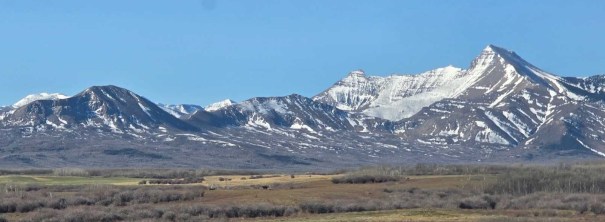
A panoramic view of snow-capped mountains under a clear blue sky, with a foreground of grassy fields.
This is the Horseshoe Basin and Dungarven SE2 as seen from the highway, approaching Waterton National Park. Dungarvan SE2 is the highest point in the photo, while Lakeview Peak is in the middle, just left of the col.

Gear

Hiking boots, poles and regular day pack kit.

Overview

From the trailhead, go Left at the first Horseshoe Basin sign, and then veer right at the second sign. Continue on this well defined trail, crossing a few creeks. Continue to the end of the valley, and take the switchbacks to the col. Turn left, and head up the spine to the summit of Dungarvan SE2. Return to the col. Hike past the switchbacks, and ascend the high point of Lakeview Ridge. Head south to complete the ridge. At the end, we descended off the west side for a lower angle descent. Connect with the trail, and hike back to the trail head.

Totals – Downloadable Tracks on Gaia, Displayed on Strava

Date: May 1, 2025
Group:  Two (Alisen and Bradley)
Distance:  23.15 km
Elevation:  1,552 m (5,122′)
Time:  9 hours 30 minutes (includes lunch and breaks)
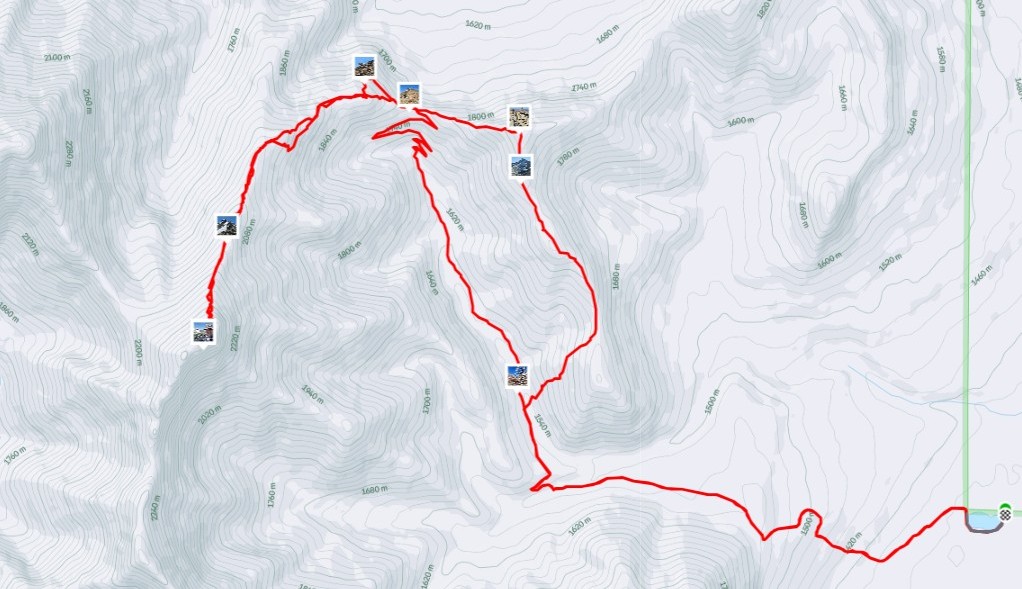
Detailed map of the hiking route taken, showing elevation contours and key waypoints.
The Dungarvan SE2 summit is accessed from the Horseshoe Basin trail. If you want to avoid the long ridge and knee-pounding descent, I’d recommend retracing your steps off Lakeview and taking the switchbacks back down.
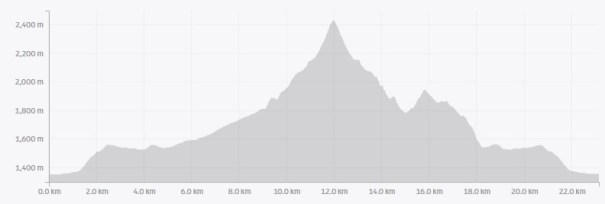
Elevation profile chart showing a steep climb to a peak and gradual descent, with distances labeled along the x-axis and elevation in meters on the y-axis.
The major elevation gain doesn’t start until the base of the summit block. The lower Lakeview Ridge summit is still a bit of a grind after the Dungarvan summit, but worth it.

Parking and Trail Head

We drove to the Bison Paddock in Waterton National Park (prior to the gates), and parked at the end of the road. Other than an info board, there are no facilities or outhouses. We unlocked the gate, and secured it behind us.

This is also the start of the Horseshoe Basin, a 20 km loop of the lower hills in the area. We followed the trail around the Indian Springs, and then turned Left at the first sign for the Horseshoe Basin. After about 1 km, we veered right to stay on the Horseshoe Basin trail.
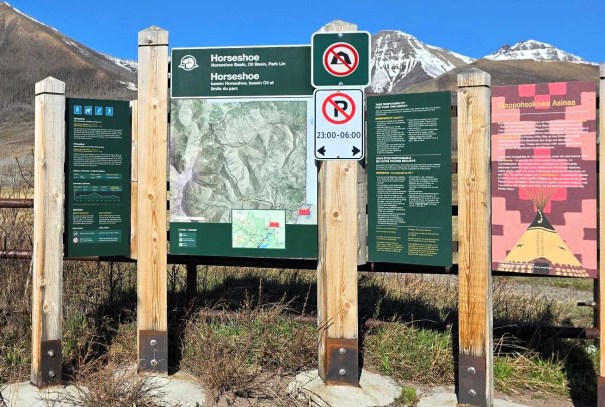
Signage at the Horseshoe Basin trailhead in Waterton National Park, featuring a detailed map, trail regulations, and information about the area.
The signboard at the end of the road, describing the Horseshoe Basin. The Bison Paddock is to the left. Dungarvan is in the background.
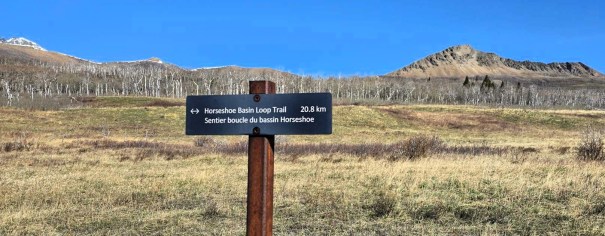
Trail sign indicating the 'Horseshoe Basin Loop Trail' with a distance of 20.8 km, set against a backdrop of grassy fields and distant mountains under a clear blue sky.
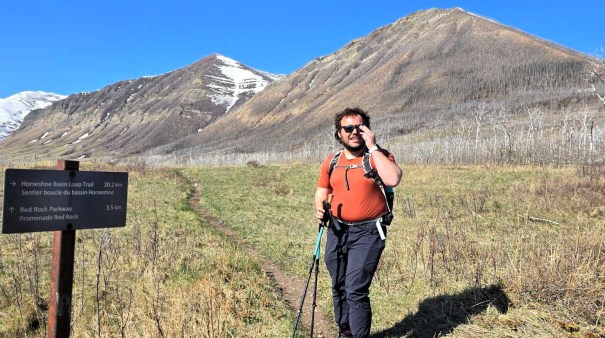
The first intersection – go left to skip the 20 km warm up of the Horseshoe Basin.
A hiker standing on a trail near a signpost indicating the Horseshoe Basin Loop Trail, with mountains in the background and snow-capped peaks visible.
Go right at the next sign. Going straight will take you to Red Rock Canyon road. We hiked over the tail end of the ridge behind Bradley, and then descended down to the creek crossing.

Main Trail

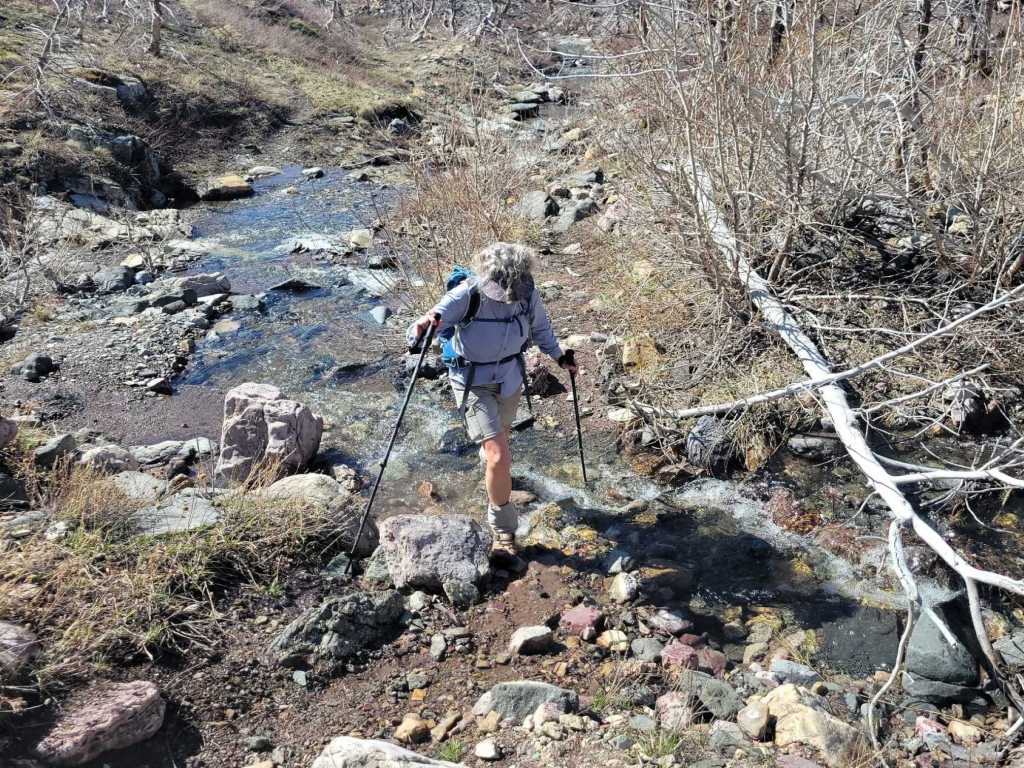
The trail went up and over a small hill, and then descended down to the low point, and a creek crossing. There was a good crossing spot, with lots of nicely placed rocks. We then followed the creek bed, gently gaining back some elevation. We crossed the creek two more times. At the end of the valley, we hit a wall. Not to worry, there’s an excellent National Park switchback trail up the col. Barely even broke a sweat.

A hiker walks along a grassy trail through a forest of dead trees with a mountain peak in the background under a clear blue sky.
Hiking up the small hill, only to lose our elevation a minute later.
A view of a mountainous landscape featuring a grassy trail leading towards sloped hills with patches of snow and clear blue skies.
At the high point of the little hill. Straight ahead is the end of the Lakeview Ridge, and the furthest point is the Dungarvan SE2 summit.
A scenic view of a valley with a stream and mountains in the background, featuring patches of snow on the peaks and clear blue skies.
After hiking down the little hill, we crossed the creek.
A hiker navigating through a rocky creek bed, using trekking poles for support. The surrounding area features dry grass, scattered stones, and bare tree branches.
The trail follows the creek, with two more crossings. Photo credit: Bradley Lawson.
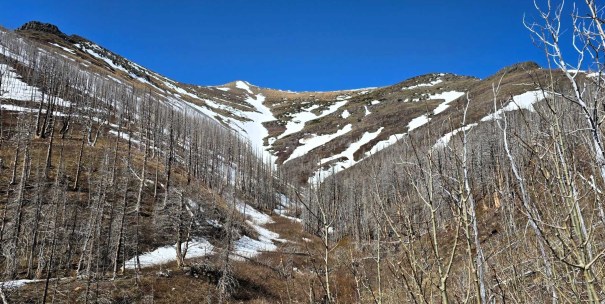
A mountainous landscape featuring a blue sky, with patches of snow on the slopes and bare trees in the foreground.
The valley ends with this cirque. Not to worry, and excellent National Park switchback trail goes up the side on the right.
A panoramic view of a valley in Waterton National Park, showcasing a mixture of burned trees and greenery, with distant mountains partially covered in snow against a clear blue sky.
Looking back down into the valley. The lovely switchback trail is on the left.

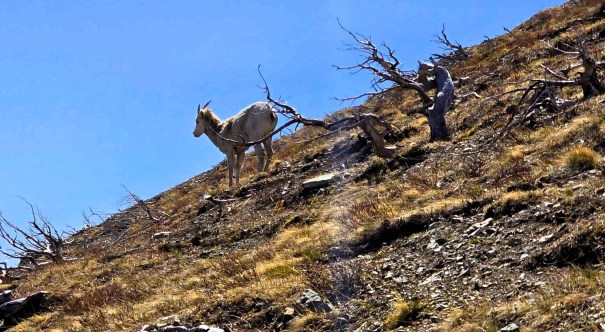
At the col, I shook off one tick from my pant leg, and then we went left to ascend the Dungarvan ridge. There was a really big trail beaten in, so we followed it around to the right. We thought it would switchback up the backside of the ridge, but it never really did anything. We abandoned the trail, and hoofed it straight up to the first big nubbin. We saw a female Rocky Mountain Sheep on this section, so all was not lost.
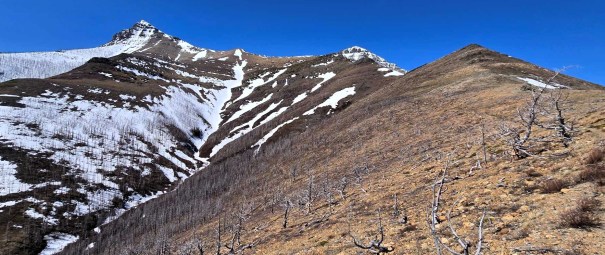
Mountain landscape featuring snow-capped peaks and a clear blue sky, with a foreground of barren land and dead trees.
At the col, looking up at the Dungarvan ridge. Just head straight up, ignoring the large trail on the right.
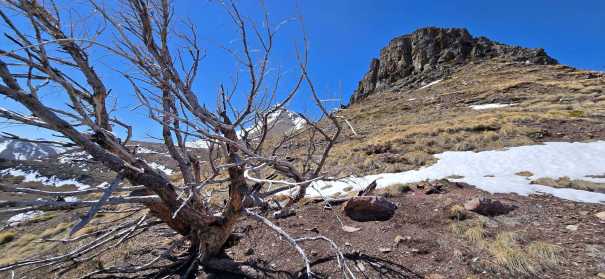
A gnarled, dead tree stands prominently on rocky terrain under a clear blue sky.
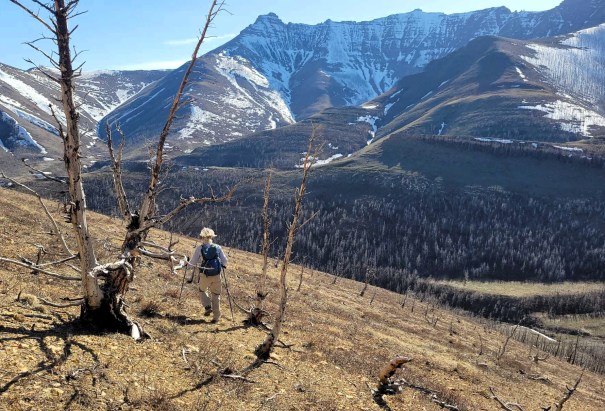
While the Kenow Fire was devastating, it’s left us with some amazing trees.
A female Rocky Mountain Sheep on a rocky slope with dried grass and sparse trees in Waterton National Park.
A lone Rocky Mountain Sheep. I wonder where her herd went?

Once on the ridge, we stayed as close to the ridge top as possible. At the dark wall, we skirted to the left. I was tired from my previous summits, and Bradley is a new dad, so neither of us were overly stoked. There was a stiff breeze on the ridge, but no gusts. Nothing that required more than a light windbreaker.
A barren landscape featuring a dry, leafless tree in the foreground with rocky terrain and a mountainous peak in the background, partially covered in snow under a clear blue sky.
This dark band is the only scrambling bit on the route. Can be by-passed on the left.
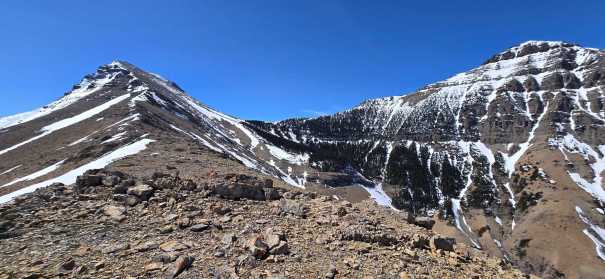
Panoramic view of rocky mountain peaks with patches of snow and clear blue sky.
The upper ridge is nice and wide, with several small rock piles to scramble over. This also shows the connector over to the main Dungarvan summit on the right.
Looking back down the ridge. Lakeview summit is far right.

Once at the base of the steep climb to the summit, we eyed up the route a bit. There was some lingering snow, that we elected to avoid as much as possible. I’d probably just stick to the ridge edge in dry conditions, but we needed to skirt to the right. We weren’t the only ones, and found a few nice trails starting to develop in the scree.

A steep, rocky mountain peak with snow patches under a clear blue sky.
The final summit block. The steepness goes up a notch here.
A hiker navigating rocky terrain on a mountain slope, with snow patches and distant valleys visible in the background.
The rock is changing to larger chunks the higher we get.

Dungarvan SE2 Summit

As we neared the summit, the rock changed to larger slabs, with a few bigger boulders to navigate around or over. The summit is a short ridge to a nice big summit cairn. We had the option of continuing to the next lower point, but the hard packed/icy snow was not enticing.
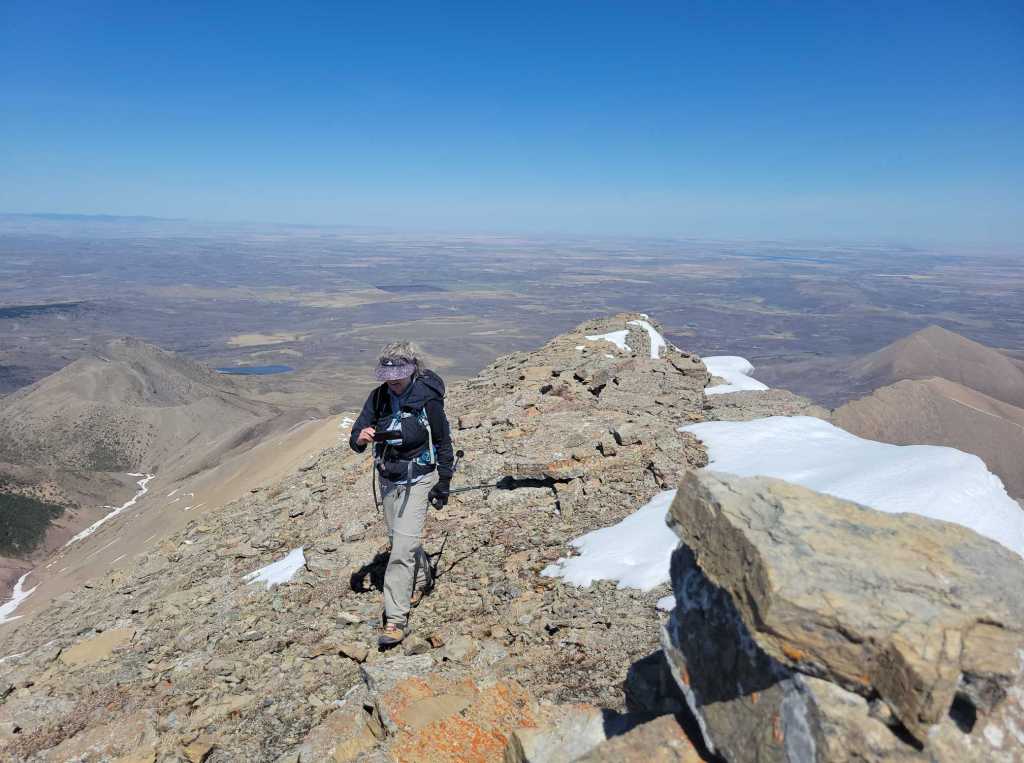
A hiker navigating rocky terrain near a summit, with a panoramic view of the surrounding landscape, including patches of snow and distant hills under a clear blue sky.
Alisen on the short summit ridge, just below the cairn. Photo credit: Bradley Lawson.
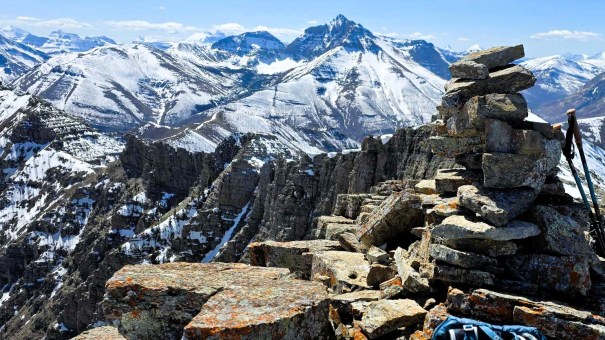
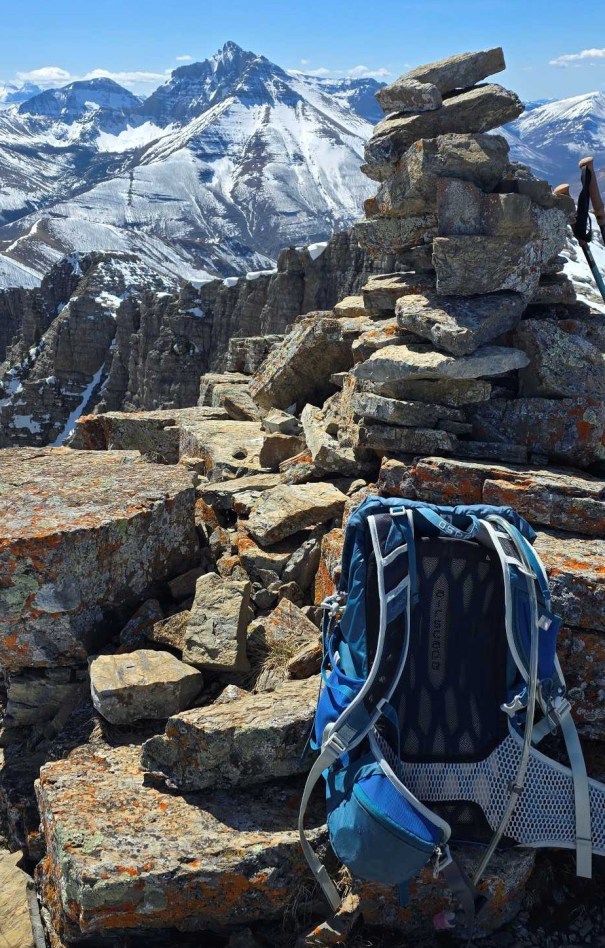
Summit view featuring a stone cairn and a blue backpack on rocky terrain, with snowy mountains in the background.
Alisen’s pack at the summit of Dungarvan SE2.

Time to summit was five hours. Distance was 12 km and ~1,050 m elevation gain.

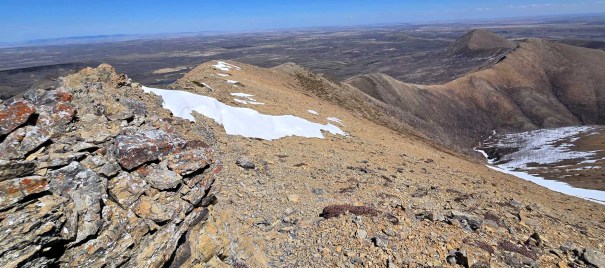
A panoramic view from a mountain summit, showcasing rugged terrain with patches of snow and hills in the distance.
Looking down at the colourful Horseshoe Basin from the summit. After we hiked the summit of Lakeview (highpoint of Horseshoe Basin), we descended off the Lakeview ridge at the far right, through the final gully on the right. This was less steep than off the very back of the ridge.
Summit cairn overlooking snow-covered mountains and valleys in the distance.
Mount Blakiston is to the left of the cairn. The bald ridge to the left of Blakiston is Ruby Ridge.
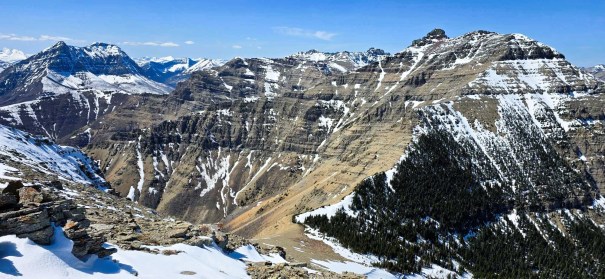
A panoramic view of rugged mountain peaks with snow patches and rocky terrain under a clear blue sky.
View of the Dungarvan connector.

We had a quick bite to eat, brushed off a few ticks that hitched a ride on our packs, reapplied the DEET, and then started down the same way we came up.

We followed our up track to get off the mountain summit block, and then stayed on the ridge spine almost to the end. We were now on top of the scrambly wall we avoided on the way up, and took a side gully get down.
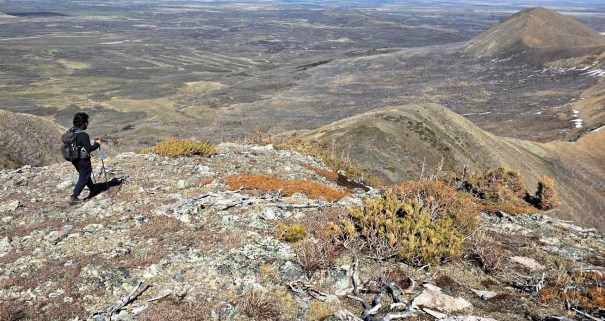
A hiker navigating rocky terrain on a mountain ridge with a vast landscape of rolling hills and valleys in the background.
On top of the dark brown scrambly bit. We found a good gully on the right to descend.
A hiker navigating a rocky trail with a steep drop-off, showcasing a rocky terrain and sparse vegetation.
Heading down the gully on the right.
A panoramic view from the summit of Dungarvan SE2, showcasing rugged ridges and valleys in a mountainous terrain under a clear blue sky.
Further down the ridge, closer to the col. Found these big colourful spines.

Lakeview Ridge Summit – High Point of Horseshoe Basin

Scenic view from a mountain ridge showing rocky terrain and patches of snow under a clear blue sky.
View of Lakeview – the summit of the Horseshoe Basin. The lower peak to the left makes up the return loop.

Once back at the col, we hiked past the top of the switchbacks, and made our way up the ridge to hit the high point of the Horseshoe Basin – Lakeview! There are some bigger boulders to scramble over on the left, or just plain old scree on the right. At the top, we found a cairn and a geological survey marker.
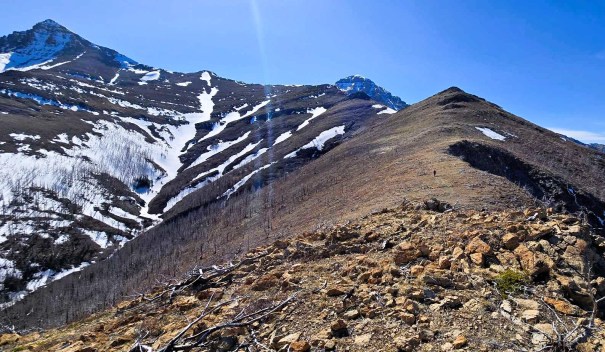
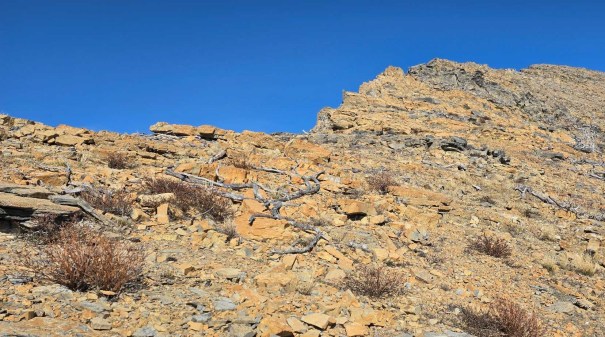
A panoramic view of a rocky ridge leading towards distant snowy mountains under a clear blue sky.
Alisen looking back at Bradley at the col, above the switchbacks.
Rocky terrain with loose stones and sparse vegetation under a clear blue sky.
Easy hiking up to the summit. The closer to the edge, the rocks are bigger with some larger boulders to scramble over if you choose.
A rocky summit identified by a cairn and a small flagpole, set against a clear blue sky.
The Lakeview summit cairn!
Survey marker embedded in a rocky surface, surrounded by small stones and vegetation.
Geological survey marker for Lakeview.
A majestic mountain peak with a ridged summit, showcasing patches of snow and rocky terrain against a clear blue sky.
Excellent view of Dungarvan SE2 from the summit of Lakeview. The ridge on the right (not snowy) is an optional ascent/descent route off Dungarvan if you want to streamline your route and miss the switchbacks.

Total time to the top of Lakeview was seven hours. Total distance was 15.8 km and elevation gain of about 1,550 m.

As the day was getting on, we both turned off Airplane mode to text our families we were still alive, and still going. We then headed south to hike the several bumps that make up Lakeview Ridge. Before the final bump, we decided to take the more gentle descent off to the west, instead of going straight down the south side. We angled down to the creek bed and trail below. It was SO nice to be on a flat trail again, and we picked up the pace for this section.

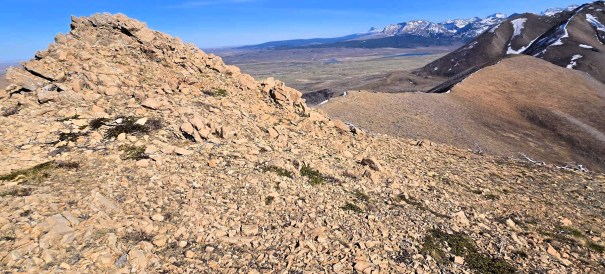
A scenic view of a rugged mountain ridge covered partially in snow, with rolling hills and distant peaks in the background.
A long look down Lakeview Ridge, which is the west side of the Horseshoe Basin. One bump after the other. The mountain at the end is Belleview Hill, which connects to Mount Galwey.
Rocky terrain at the summit of Dungarvan SE2, with panoramic views of the valley and snow-capped mountains in the distance.
Looking down to the end of Lakeview Ridge. At the final col, we angled right and started our descent. This was A) a little less steep than the south end, and B) lead directly to the flat trail below.
A hiker with trekking poles walking through a mountainous landscape featuring snow-capped peaks and a valley with burnt trees.
Alisen angling off the west side of the ridge. This area was burned during the 2017 fires, and we’d avoid some deadfall lower down. Mount Galwey on the horizon.

At the big creek crossing, we took 5 minutes to splash off the sweat and dust, and felt reinvigorated for the final 3 km or so back to the car.
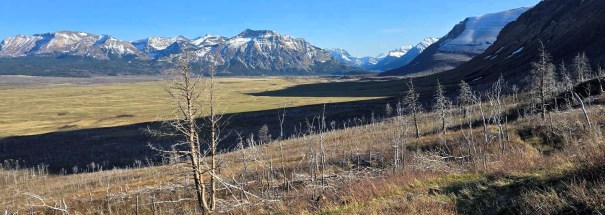
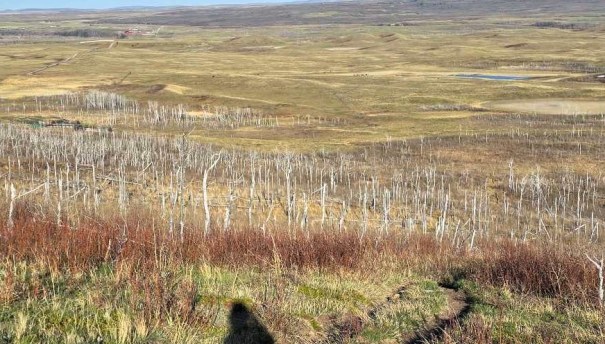
Wide panoramic view of a mountainous landscape, showcasing snow-capped peaks and a vast, open valley with dry grass and scattered trees.
This is after the creek crossing, and once again at the little hump above the parking lot. This is a great view looking towards Waterton Lakes.
Wide view of a hilly landscape with patches of grass and sparse, tall white tree stumps, against a clear blue sky.
This is looking down on the Bison Paddock. The big brown dots are the bison. Our vehicle is in the upper left corner, at the end of the road.

The Bison decided to wander over to us, and we saw several of these big and beautiful beasts very close to the fence. A nice way to end the hike!
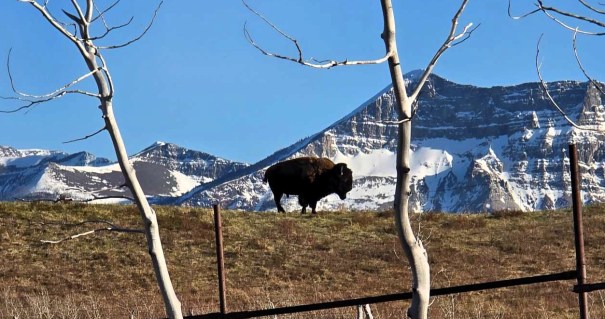
A bison stands in a grassy field with snow-capped mountains in the background, framed by bare tree branches.
A bison perfectly situated on the hill with the mountain behind. Thanks buddy! It was great to see you.

Back at the car, we both shook out our hair and clothes to rid ourselves of any ticks. I even switched into a full set of new clothes. Bradley found one tick on his arm while driving home, and I found a tick in my hair during the shower. Bradley said he found four more ticks in his car after he got home. I left my backpack in the garage, and my clothes went straight into the washing machine. Fingers crossed I found all the ticks!

Wrap Up

I love Waterton for early season routes. While May 1st is pretty darn early, the Dungarvan and Horseshoe Basin routes were both in excellent shape. Even if you don’t want to summit Dargarvan, the Horseshoe Basin is a worthy hiking objective.

Thanks for reading! You can follow my blog, join my FaceBook page Al’s Adventurers, or follow me on Instagram

Alisen

Unknown's avatar

I love all things mountains! I live next door to the Canadian Rocky Mountains, however I travel the world to enjoy the many different mountain environments and cultures that I can. I hope you enjoy these trip reports, and that it inspires you to accomplish your own adventure goals.

Tagged with: , , , , , , , , , , , , , ,
Posted in Adventures, Hiking, Scrambling
10 comments on “Dungarven SE2 and LakeView
  1. Fantastic and honest trip report! The mix of scenic beauty, tough climbs, and tick chaos really brought the hike to life. Loved the route breakdown and your reflections—especially powering through after Swansea. Despite the pests, sounds like a memorable day in Waterton. Thanks for sharing!

    • alisendopf's avatar alisendopf says:

      Awww, thank you very much. I love YOUR recap of the day. The powering through is the hardest part. I will admit to being done on the final ridge, and just wanting to get back down. Thank you so much for stopping by!

      • You’re so welcome! Totally get that feeling on the final ridge—sometimes it’s sheer willpower that gets us through. But you did it, and your story captured that perseverance so well. Looking forward to reading more of your adventures!

  2. Ticks can survive being washed; they can’t survive being dried. During tick season (which starts now where we are), we dry first, then wash.

    • alisendopf's avatar alisendopf says:

      I’m hoping they cannot survive a trip down my drain pipe! 🙂 My hiking buddy told me that ticks can survive for up to 300 days without blood. Whole new terror unlocked.

  3. Diana's avatar Diana says:

    Lovely views as always! But ew ew ew, I think the ticks might have chased me away from this one.

    • alisendopf's avatar alisendopf says:

      I hear you Diana. Unfortunately, spring is always tick season, but they are particularly bad this year. Last weekend was the first mountain I did this year when I did NOT bring home a tick. So gross!

  4. Sounds like a nice hike minus all the ticks! And here I thought you only really get ticks when you’re hiking near or in the grass or bushes. Beautiful pictures from along the trail. Looks like you had nice weather. Love the bison sighting at the end!

    • alisendopf's avatar alisendopf says:

      You are absolutely right Linda – ticks usually get you in the long grass. I’ve heard that this is a really bad year for ticks. Usually they are way worse in BC, but I think with our lack of cold winters, and shorter winters, the Alberta ticks are increasing in numbers. They are absolutely gross. Good news – the tick season is almost over and last weekend I came home with ZERO ticks. Woot! Woot!

Leave a reply to alisendopf Cancel reply

This site uses Akismet to reduce spam. Learn how your comment data is processed.